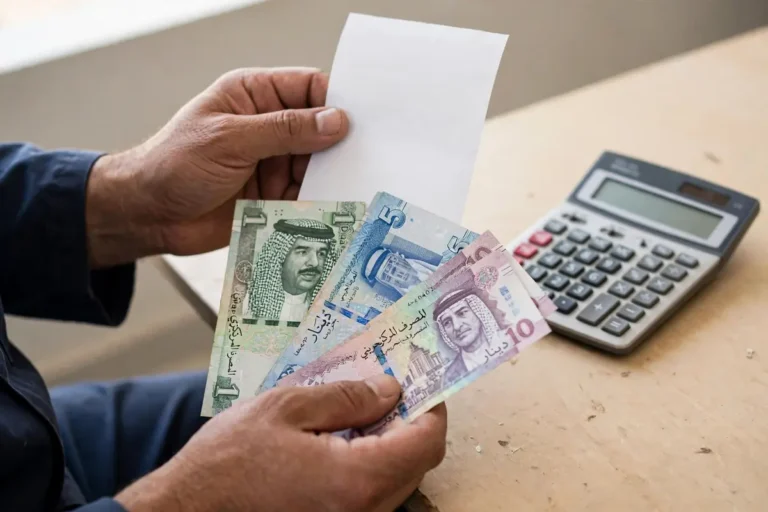
How to Read Your Bahrain Salary Slip: Every Line and Deduction Explained
Your Bahrain salary slip — also called a payslip — is the one document that shows exactly what you were promised, what you actually earned in a month, what was taken out, and what reached your bank account. If the amount in your account looks smaller than the salary in your offer letter, the answer is almost always on the slip itself. This guide walks through each line, in plain language, so you can check your own slip in a few minutes and spot a mistake before it repeats for months.
This is an independent explanatory guide, not an official document. For the current official rates, always verify with the Social Insurance Organization (SIO) at sio.gov.bh. If you want a quick gross-to-net figure to compare with your slip, use the Bahrain Salary Calculator.
Bahrain Payslip Verifier — check your slip
Enter the figures from your salary slip. This tool estimates your gross pay, SIO employee deduction, employer’s separate SIO share and net pay, so you can compare them with your slip. It is an estimate for checking only — your employer’s payroll record and the SIO’s current rules are authoritative if they differ.
How it works: gross = basic + all allowances entered. Insurable wage = gross capped at BHD 4,000. Employee SIO = 8% (Bahraini) or 1% (expatriate) of the insurable wage. Employer SIO (18% Bahraini / 3% expatriate) is shown for information only and is never subtracted from your net pay. No data is collected or sent anywhere — all maths runs in your browser. Note: one-off payments such as a bonus may be treated differently by payroll; if your slip includes one, compare the regular-pay lines first.
What a Bahrain salary slip is, and why you should keep every one
A salary slip is your employer’s monthly statement of your pay. A complete slip normally shows who you are, who employs you, which month the pay covers, each earning separately, each deduction separately, and the final net pay. It is not just a receipt. Banks, landlords and visa offices commonly ask for recent slips as proof of income, and if a pay dispute ever arises, your slips are your evidence of what was actually paid and deducted.
Keep a copy of every month’s slip, ideally as a PDF or a clear photo, separate from your work email. If you change jobs, you may lose access to your old employer’s payroll portal, and reconstructing a missing month later is far harder than saving the file now.
The four blocks on almost every Bahrain payslip
Layouts differ from company to company — some slips are a single table, others split earnings and deductions into two columns — but the blocks are the same:
- Header details: your name, employee number, job title, department, and the pay period (for example, October 2026) and pay date. Check the pay period first: a slip for the wrong month explains many apparent “errors”.
- Earnings: everything added to your pay that month, listed line by line.
- Deductions: everything taken out before payment, listed line by line.
- Net pay: total earnings minus total deductions. This is the figure that should match the amount credited to your bank account.
The single most useful habit is to read the slip in that order — period, earnings, deductions, net — rather than jumping straight to the bottom line. A wrong net figure is usually caused by one wrong line above it, and finding that line is what lets you ask HR a precise question.
Basic salary vs allowances: the earnings side, line by line
Basic salary
Basic salary is the core, contracted monthly pay for your job, before anything is added. It is the figure most other calculations refer back to — overtime, leave pay and end-of-service calculations commonly use the basic salary, or the basic salary plus a defined allowance, as their starting point, so a basic salary that is lower than your offer letter is worth querying immediately.
Allowances
Allowances are regular extra payments on top of basic salary, and a good slip lists each one separately rather than lumping them into one line. The most common are:
- Housing allowance — a fixed monthly amount towards accommodation.
- Transport allowance — a fixed monthly amount towards travel to work.
- Other regular allowances — for example a food, phone or responsibility allowance, depending on your contract.
Why the split matters: your gross pay is the basic salary plus all of these allowances, and the SIO deduction is calculated on the insurable wage, which is the basic salary plus regular monthly allowances (see below). If your employer merges allowances into a single “allowances” line, you cannot check that each contracted allowance was actually paid in full. Ask for an itemised breakdown if yours is lumped together.
Variable additions: overtime, bonus and arrears
Some months carry extra lines: overtime for extra hours worked, a bonus, commission, or arrears (pay owed from an earlier month, paid late). These are not part of your normal monthly salary, so a month with overtime or a bonus will show a higher gross — and a slightly higher SIO deduction — than a normal month. That is expected, not an error, provided the extra amount itself is right. If an arrears line appears, ask HR which month it relates to, so you can check it was not already paid.
Gross pay: the one addition to check first
Gross pay is simply the total of all earnings for the month:
Gross pay = basic salary + all allowances + overtime, bonus or arrears (if any).
Add the earnings lines yourself. If your addition does not match the printed gross, that is the first thing to raise with HR — everything below it, including the deduction, will be wrong too. Most slips get this right, but it takes ten seconds to confirm, and it rules out the simplest class of payroll error.
The SIO deduction: the one mandatory deduction on most Bahrain slips
Bahrain has no personal income tax, so you will not see an income-tax line on a standard Bahrain payslip. For most employees, the only mandatory deduction is the employee’s SIO (Social Insurance Organization) contribution. This is the line that most often surprises people, especially expatriates who were told their salary was “tax-free” — tax-free does not mean deduction-free.
The employee deduction depends on whether you are a Bahraini national or an expatriate, and it is calculated on the insurable wage (basic salary plus regular monthly allowances), capped at BHD 4,000 per month. In other words, if your insurable wage is above BHD 4,000, the deduction is calculated on BHD 4,000, not on the full amount.
| Employee type | Employee SIO deduction (2026) | What it covers, in brief |
|---|---|---|
| Bahraini national | 8% of insurable wage (7% pension + 1% unemployment), capped at BHD 4,000 | Pension and unemployment cover under the SIO scheme |
| Expatriate (non-GCC) | 1% of insurable wage, capped at BHD 4,000 | The employee’s share of the SIO scheme (see note in sources: sources differ on the branch label for this 1%) |
Worked example: a Bahraini employee with a gross of BHD 1,240 pays 8% × 1,240 = BHD 99.20. An expatriate on the same gross pays 1% × 1,240 = BHD 12.40. Same gross, very different deduction — which is why two colleagues on the same headline salary can take home different amounts, and why comparing slips with a colleague of a different nationality is misleading.
Because of the BHD 4,000 cap, the maximum monthly employee deduction is BHD 320 for a Bahraini employee (8% × 4,000) and BHD 40 for an expatriate (1% × 4,000). If your slip shows a deduction above those figures on a single month’s regular pay, ask HR to explain the basis — a one-off bonus month can complicate this, so check whether the extra relates to a variable payment.
What your employer pays separately — and why it is not deducted from you
This is the most misunderstood part of a Bahrain payslip. Your employer also pays SIO contributions, but those are the employer’s cost, on top of your salary — they are not deducted from your pay. Some slips show the employer’s share for information, and readers sometimes mistake it for a second deduction. It is not: your net pay is gross minus your deductions only.
| Employee type | Employer SIO (2026, paid separately) | Your deduction |
|---|---|---|
| Bahraini national | 18% of insurable wage, capped at BHD 4,000 | 8% |
| Expatriate (non-GCC) | 3% of insurable wage, capped at BHD 4,000 | 1% |
For expatriate employees there is one more employer-only cost that never appears as a deduction from your pay: the end-of-service contribution. Since March 2024, private-sector employers have paid a monthly contribution to the SIO towards each expatriate worker’s end-of-service benefit — 4.2% of monthly wage for the first three years of service, rising to 8.4% after that — instead of holding the whole gratuity until you leave. You do not pay this, and it should not reduce your net pay; if you want the full picture of how that benefit works, see our guide to end-of-service benefits in Bahrain.
The practical test is simple: add up only the lines in the deductions column. If the employer’s share is printed on the slip, it should sit outside that column, or be clearly labelled as the employer’s contribution. If your net pay was worked out by subtracting the employer’s share as well, that is an error worth raising in writing.
Annotated example: a Bahraini employee’s payslip
The table below is a worked example using the same figures as the calculator examples on this site, so you can follow every line. It is an example, not a real person’s slip.
| Line on the slip | Amount (BHD) | How to read it |
|---|---|---|
| Basic salary | 850.00 | Core contracted pay |
| Housing allowance | 250.00 | Regular allowance, itemised |
| Transport allowance | 75.00 | Regular allowance, itemised |
| Other allowance | 65.00 | Regular allowance, itemised |
| Gross pay | 1,240.00 | 850 + 250 + 75 + 65 |
| SIO employee deduction (8%) | −99.20 | 8% × 1,240 (below the BHD 4,000 cap, so the full gross is insurable) |
| Net pay | 1,140.80 | 1,240.00 − 99.20 — this should match the bank credit |
| Employer SIO (18%, information only) | 223.20 | Paid by the employer on top; NOT deducted from net pay |
For comparison, an expatriate on a BHD 1,000 basic salary with no allowances would show gross BHD 1,000, an SIO deduction of just BHD 10.00 (1%), and net pay of BHD 990.00. A Bahraini on the same BHD 1,000 would show an BHD 80.00 deduction and net pay of BHD 920.00. The headline salary is identical; the take-home is not, and the slip explains why.
Why your net pay is lower than your offer letter (the five usual reasons)
- You compared gross with net. Offer letters usually state the gross package (basic plus allowances). Your bank receives the net, after the SIO deduction. The gap for a Bahraini employee is 8% of the insurable wage; for an expatriate, 1%.
- An allowance is missing or lower than promised. Check each allowance line against your contract, not just the total. A missing housing allowance is easy to overlook inside a lumped total.
- An extra deduction appeared. Apart from SIO, deductions on a Bahrain slip should be things you agreed to or were notified of: a salary advance being repaid, an agreed loan instalment, or a deduction for unpaid leave days. An unexplained line with a vague label (“adjustment”, “other deduction”) deserves a written explanation from HR.
- Unpaid leave or absence days were deducted. Paid leave does not reduce your pay; unpaid leave does, for the days not worked. If your leave balance or attendance record is wrong, the deduction will be wrong too — and a deduction for leave salary in Bahrain should follow the rules for that leave type, not an arbitrary daily rate.
- It is a short or first month. If you joined mid-month, your first slip is usually pro-rated for the days actually worked, so it will be lower than a full month. The same applies to a final month if you leave mid-month. Check the pay period and the number of days paid before assuming an error.
Real problems workers actually run into — and how to handle each one
“My offer letter mentioned no deduction, but 1% was taken” (expatriates)
This is one of the most commonly asked questions by expatriate workers in Bahrain: a 1% deduction appears in the first month even though the offer letter said nothing about deductions. In most cases that 1% is the legitimate expatriate employee SIO share. It is small, but it is real, and it should be labelled as SIO on the slip. What to do: confirm the label and the maths (1% of your insurable wage, capped at BHD 4,000). If the label is missing or the percentage is not 1%, ask HR to identify the deduction in writing. Do not assume an unlabelled 1% is SIO until it is confirmed.
“My employer deducted their share too”
If your net pay equals gross minus both your share and the employer’s share (for example, minus 26% for a Bahraini employee instead of 8%), the employer’s contribution has wrongly been passed to you. Raise it promptly and in writing, showing your own calculation, and keep the slip. This is exactly the kind of error that, left alone, repeats every month.
“My salary arrived late, or less than the slip says”
Private-sector wages in Bahrain are paid through the Wage Protection System (WPS), which records salary transfers electronically. If the bank credit does not match the slip’s net pay, or the payment is late, first compare the slip, the bank credit and your contract, then ask HR for the WPS/bank transfer record for that month. Keep the slip, the bank statement line and any written reply together — they are the documents any later complaint would rely on.
“A deduction I never agreed to appeared”
Any deduction beyond SIO should have a basis you can point to: a signed advance or loan agreement, an unpaid-leave record, or a court or statutory order. If you cannot find that basis, ask HR for it in writing before the next payroll run. Do not accept a verbal “it is company policy” for a deduction from your contracted wage without seeing the policy or agreement it rests on.
How to check your slip in five minutes
- Confirm the pay period and that the basic salary matches your contract.
- Add the earnings lines yourself and compare with the printed gross.
- Check each allowance separately against your contract.
- Work out the SIO deduction: 8% (Bahraini) or 1% (expatriate) of the insurable wage, capped at BHD 4,000 — and confirm no employer share was subtracted.
- Compare the net pay with the actual bank credit, to the fils.
The payslip verifier included with this post does steps 2 to 4 for you: enter your basic salary, allowances and employee type, and it shows the gross, the SIO deduction, the employer’s separate share and the net, so you can compare directly with your slip. It is an estimate tool for checking, not a payroll system — your employer’s payroll record and the SIO’s current rules are authoritative if they differ.
What to do if your slip is wrong or missing
Start with HR or payroll, in writing (email is better than a corridor conversation), stating the month, the line you dispute, your calculation, and what you expect to be corrected. Give a reasonable time for the next payroll run to correct it. If the issue is not resolved, or if slips are repeatedly missing or wages repeatedly late, keep every slip, bank statement and written exchange, and seek guidance from the relevant Bahrain labour authority — the LMRA and the Ministry of Labour handle private-sector wage matters, and the SIO can confirm contribution questions. This guide is general information, not legal advice, and a specific dispute may need professional advice.
One related point: your net pay, not your gross, is the realistic figure for monthly budgeting. If you are working out whether a salary covers rent, food and transport, our guide to the cost of living in Bahrain uses take-home pay as its starting point for exactly that reason.
Frequently asked questions about Bahrain salary slips
Why is there no income tax line on my Bahrain salary slip?
Because Bahrain levies no personal income tax. The absence of a tax line is normal, not an omission. The mandatory deduction you should expect is the SIO employee contribution: 8% for Bahraini nationals, 1% for expatriates, on the insurable wage capped at BHD 4,000 per month.
Is my employer allowed to deduct their SIO share from my salary?
No — the employer share (18% for Bahraini employees, 3% for expatriates in 2026) is the employer’s cost, paid on top of your salary. Your net pay is gross minus your own deductions only. If both shares were subtracted, ask HR to correct it in writing.
Why did my colleague and I get different net pay on the same gross salary?
Most commonly because the employee SIO rate differs by nationality (8% vs 1%), or because one of you had a variable item — overtime, a bonus, unpaid leave or an advance repayment — that the other did not. Compare the individual lines, not just the totals.
What if my slip shows a lumped “total allowances” figure instead of each allowance?
Ask payroll for an itemised breakdown. You cannot verify that each contracted allowance was paid in full from a single lumped figure, and itemisation is what lets you spot a missing allowance quickly.
Should I keep old salary slips after leaving a job?
Yes. Keep at least the last 12 months, and ideally your full set. Slips are used as proof of income for loans, rentals and visa applications, and as evidence for end-of-service and leave calculations. Save them outside your work email before your last day.
Rates in this post are the 2026 SIO rates as published by payroll and SIO reporting in 2026 and summarised in our sources file; confirm the rate that applies to you with the SIO at sio.gov.bh before relying on it for a dispute, as rates change by law — the Bahraini employer rate, for example, has risen by one percentage point each January under the 2022 reform. This post is general information, not legal or financial advice.
About the Author
Muhammad Ahmad is an independent publisher who researches and writes Bahrain salary guides. Figures are researched from official sources including the Social Insurance Organization (SIO) and the Labour Market Regulatory Authority (LMRA) and are reviewed for 2026 rates. This site is not affiliated with the SIO or the Government of Bahrain, and all figures are estimates — confirm your exact figures with your employer or the SIO.