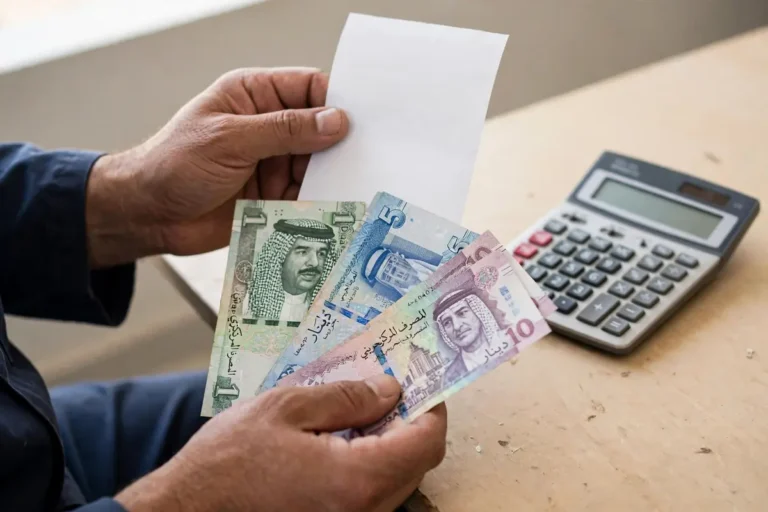
Leave Salary in Bahrain: How Annual Leave Pay Is Calculated
If you work in Bahrain’s private sector, “leave salary” usually means one of two things: the pay you receive while you are on annual leave, or the cash payment for annual leave days you have earned but not taken. The second meaning is where most confusion — and most disputes — happen. This guide explains how leave salary in Bahrain is calculated, which salary figure the law uses, and how to check your own payment before you accept it.
This is general information about Bahrain’s private-sector Labour Law, not legal advice for an individual case. Your employment contract can give you more than the legal minimum, but it cannot give you less. If your contract and this guide disagree, read your contract first and verify the current law through an official government source.
Leave Salary Calculator — Bahrain
Estimates the cash value of unused annual leave on the statutory basis in Article 47 of Labour Law No. 36 of 2012: last basic wage + social allowance, if any.
Please enter a basic wage of 0 or more and unused days between 0 and 365.
Estimate only. Formula: (basic wage + social allowance) ÷ 30 × unused days. The ÷ 30 step is the standard payroll convention of treating a month as 30 days. Housing, transport and other allowances are not included, because Article 47 adds only the social allowance. Your contract may pay more — for example, on full salary — in which case the contract figure applies. This tool collects no data: all calculation happens in your browser. This is not legal advice.
What Leave Salary Means in Bahrain
In everyday use, three different payments are often all called "leave salary". Keeping them apart makes the calculation much clearer:
- Pay during annual leave: your pay while you are actually away on approved annual leave.
- Leave encashment: a cash payment instead of taking some of your annual leave days, where your employer's rules allow it.
- Unused leave on leaving: the payment for your remaining annual leave balance when your employment ends before you have used it.
This post focuses mainly on the second and third cases, because those are the ones calculated from a specific salary figure under the law. The tool at the top of this post estimates the cash value of an unused leave balance on that statutory basis.
How Many Annual Leave Days Do You Get in Bahrain?
Under Article 58 of Bahrain's Labour Law for the Private Sector (Law No. 36 of 2012), a worker who has completed at least one year of service with an employer is entitled to paid annual leave of not less than 30 days, accruing at 2.5 days for each month. If you have worked for less than one year, you are entitled to leave in proportion to your period of service in that year — for example, six months of service accrues 15 days (6 × 2.5).
Article 59 adds the practical rules around that entitlement:
- The employer sets the dates of annual leave according to business requirements, and the worker takes leave on the date and for the period fixed by the employer — except where the worker is sitting an educational examination, in which case Article 61 lets the worker choose the dates if at least 30 days' notice is given.
- In all cases, a worker must have annual leave of 15 days in the year, including no less than six consecutive days.
- Up to six days a year for a contingency reason, with a maximum of two days in each case, count as part of the annual leave entitlement.
- The employer must settle the balance of annual leave and the corresponding wage every two years at most. If employment is terminated before a worker has used the annual leave balance, the worker is entitled to receive the wages for that balance.
The 30 days are calendar days under the statutory scheme, not working days. That distinction matters for the calculation below: do not convert a statutory 30-day entitlement into working days unless your own contract expressly grants leave in working days, which would be a different — and more generous — arrangement.
The Rule That Decides the Amount: Article 47
Article 47 of the same law sets the salary basis for several end-of-service payments, including the compensation for the annual leave balance specified in Article 59. In plain terms, it says:
Compensation for the annual leave balance is calculated on the basis of the worker's last (most recent) basic wage, plus the social allowance, if any.
Two parts of that sentence do most of the work:
"Last" basic wage. The calculation uses your basic wage at the time the payment falls due, not the basic wage you had when the leave was earned. If your basic salary rose during the year, the leave balance is valued at the newer, higher basic wage — and the same applies in reverse if it fell.
"Plus the social allowance, if any." The social allowance is the one allowance the law expressly adds to the basic wage for this calculation. Other allowances are not added by Article 47 itself. If you have no social allowance, the basis is simply your last basic wage.
For workers paid by piecework or production, or who receive a fixed wage plus a commission or percentage, Article 47 uses a different basis: the average wage over the last three months. If that describes your pay, the simple basic-plus-social formula in this post does not apply directly to you.
Basic or Gross? Solving the Most Common Confusion
Ask expatriate workers in Bahrain how leave salary is calculated and you will hear two confident answers: "basic salary" and "gross salary". Both answers come from real experience, which is why the question keeps coming up in expat forums. Here is how to reconcile them.
The statutory minimum for the leave-balance payment is basic wage plus social allowance. That is what Article 47 prescribes. Housing allowance, transport allowance, food allowance and other regular allowances are not part of that statutory basis.
At the same time, many employers voluntarily pay leave salary on the full salary. A contract, company policy or established company practice can be more generous than the law — and if your employer has agreed to pay on full salary, that agreement is what you should expect to receive. The confusion arises when people assume the employer's generous practice is the legal rule, or assume the legal minimum is what every employer pays. Neither assumption is safe. Check which basis your contract actually states.
| Pay component | Included in the Article 47 leave-balance basis? |
|---|---|
| Last basic wage | Yes — this is the core of the calculation |
| Social allowance (if you receive one) | Yes — expressly added by Article 47 |
| Housing, transport or other allowances | No — not added by Article 47 itself |
| Commission or percentage (fixed wage plus commission) | Special rule — average wage over the last three months |
| Any extra your contract or company policy promises | Yes, if your contract promises it — a contract can beat the legal minimum |
A related point: leave salary is not the same as end-of-service indemnity, even though Article 47 supplies the salary basis for both. Indemnity is a separate leaving payment with its own rates and qualifying rules. For the full indemnity calculation, see our guide to end-of-service benefits in Bahrain.
How to Calculate Leave Salary in Bahrain, Step by Step
For a worker on a fixed monthly basic wage, the leave-balance calculation has three steps:
Step 1 — Find the monthly basis. Add your last basic wage and your social allowance (if any). Call this your monthly leave basis.
Step 2 — Find the daily rate. Divide the monthly leave basis by 30. Payroll in Bahrain conventionally treats a month as 30 days for this purpose, so the daily rate is the monthly basis divided by 30.
Step 3 — Multiply by the unused days. Multiply the daily rate by the number of unused annual leave days being paid out.
In short:
Leave pay = (last basic wage + social allowance) ÷ 30 × unused leave days
Worked examples make the difference between the statutory basis and gross pay concrete:
| Example | Monthly leave basis (basic + social) | Daily rate (÷ 30) | Unused days | Leave pay |
|---|---|---|---|---|
| A: basic BHD 600, social allowance BHD 50 | BHD 650 | BHD 21.67 | 30 | BHD 650.00 |
| B: basic BHD 850, no social allowance | BHD 850 | BHD 28.33 | 12 | BHD 340.00 |
| C: basic BHD 400, social allowance BHD 100 | BHD 500 | BHD 16.67 | 15 | BHD 250.00 |
Example A is worth pausing on: 30 unused days at a BHD 650 monthly basis equals exactly one month's leave basis. That is a useful sanity check — a full 30-day balance should come out at about one month of basic plus social allowance, not one month of gross pay, unless your contract promises the gross figure.
Try your own figures in the leave-salary calculator above. It uses the Article 47 basis (basic plus social allowance) and labels the result as an estimate, because your contract may pay more and your employer may apply its own rounding.
Unused Leave When You Resign or Your Contract Ends
If your employment ends before you have used your annual leave, Article 59 says you are entitled to receive the wages for the remaining balance. In practice, that balance usually appears as one line in your final settlement, alongside any end-of-service indemnity and other final dues.
Three checks matter most at that point:
- Count the days correctly. Start from your accrual (2.5 days per month), subtract the days you actually took, and keep your approved leave records. A balance dispute is usually a days dispute, not a rate dispute.
- Use the last basic wage. If you were promoted or your basic salary changed, the balance is valued at the most recent basic wage plus any social allowance — not at the wage in force when the leave accrued.
- Separate leave pay from indemnity. Both use the same salary basis under Article 47, but they are different payments. Make sure your settlement shows them as separate lines so a shortfall in one is not hidden inside the other.
For workers in their first year, the same principle applies on a pro-rata basis: if you leave after eight months having taken no leave, your accrued balance is 20 days (8 × 2.5), valued at your last basic wage plus social allowance. Whether a particular employer pays a first-year balance in every case can depend on contract terms, so confirm this with your employer or HR before your last working day rather than after it.
What to Check on Your Payslip and Contract
Before you query a leave payment, gather four facts. With them, any HR or payroll conversation becomes straightforward:
- Your basic wage as shown on your payslip — not your total or gross pay. This is the figure Article 47 starts from.
- Whether you receive a social allowance, and how much. If your payslip lists allowances separately, the social allowance should be identifiable; if it is not listed separately, ask payroll to confirm whether you have one.
- What your contract says about leave pay. Look for any clause that promises leave salary on full or gross salary. If such a clause exists, it overrides the statutory minimum in your favour.
- Your leave balance in days. Ask HR for the balance in writing, with the accrual and the days taken shown separately.
If you want to see how your monthly take-home pay itself is worked out — including SIO deductions, which are a separate matter from leave pay — use the Bahrain Salary Calculator on our homepage.
Common Mistakes That Shrink (or Inflate) a Leave Payment
Dividing by working days instead of 30. Dividing a monthly wage by 22 working days and multiplying by working days of leave produces a much larger figure than the conventional monthly ÷ 30 method. Unless your contract expressly uses working days, that method does not match the statutory calculation and will not survive a payroll check.
Adding every allowance. Housing and transport allowances feel like salary — and for monthly budgeting they are — but Article 47 does not add them to the leave-balance basis. Adding them inflates the estimate and sets up a dispute you are unlikely to win on the statutory argument alone.
Forgetting the social allowance. This is the mistake in the other direction. If you do receive a social allowance and leave it out, you understate your entitlement. Always add it where it applies.
Using an old basic wage. A raise in your final months raises your leave balance value too, because Article 47 uses the last basic wage. Using the wage from the start of the leave year understates the payment.
Assuming leave can simply be waived for cash at any time. Article 58 says a worker may not waive the leave entitlement itself, though cash may be received in lieu under Article 59. In practice, encashment during employment depends on your employer's rules and the two-year settlement cycle — it is not an automatic right to convert every unused day to cash whenever you choose. The clearest statutory right to cash is the balance payable when employment ends.
Frequently Asked Questions About Leave Salary in Bahrain
Is leave salary calculated on basic or gross salary in Bahrain?
For the statutory payment for an annual leave balance, Article 47 of Labour Law No. 36 of 2012 uses the last basic wage plus the social allowance, if any — not gross salary. Some employers voluntarily pay on full salary under the contract or company policy, so always check your contract: a contractual promise of full-salary leave pay is more generous and should be honoured.
How many days of annual leave do I get per year in Bahrain?
At least 30 calendar days of paid annual leave after one year of service, accruing at 2.5 days per month. Service of less than one year gives a proportionate entitlement. At least 15 of those days, including six consecutive days, must actually be taken in the year.
What is the formula for leave salary in Bahrain?
Leave pay = (last basic wage + social allowance) ÷ 30 × unused leave days. For example, a basic wage of BHD 850 with no social allowance and 12 unused days gives BHD 850 ÷ 30 × 12 = BHD 340.00. The ÷ 30 step is the standard payroll convention of treating a month as 30 days.
Do I get paid for unused annual leave when I resign?
Yes, under Article 59, if your employment ends before you have used your annual leave balance, you are entitled to receive the wages for that balance, calculated on the Article 47 basis. The payment normally forms part of your final settlement.
Can my employer refuse to pay leave salary and offer extra days off instead?
The employer schedules when leave is taken, and the balance must be settled at most every two years. Offering future days off instead of paying a balance that is due on termination is not a substitute for the termination payment. During employment, whether unused days are carried forward or encashed depends on your contract and company policy, within the legal minimums.
Verify Before You Rely on a Figure
Labour law summaries — including this one — can go out of date, and individual contracts vary. Before acting on a disputed amount, verify the current text of the law and your own position through official government channels: the Labour Market Regulatory Authority at lmra.gov.bh, the national portal at bahrain.bh, and the Social Insurance Organisation at sio.gov.bh for social insurance matters. This site is an independent information site, not an official government site, and this post is not legal advice.
Related reading: how your monthly payslip is put together in our guide to the Bahrain salary slip, what other workers typically earn in our guide to the average salary in Bahrain, and whether your pay covers everyday costs in our guide to the cost of living in Bahrain.
About the Author
Muhammad Ahmad is an independent publisher who researches and writes Bahrain salary guides. Figures are researched from official sources including the Social Insurance Organization (SIO) and the Labour Market Regulatory Authority (LMRA) and are reviewed for 2026 rates. This site is not affiliated with the SIO or the Government of Bahrain, and all figures are estimates — confirm your exact figures with your employer or the SIO.